Home / Articles
What You Need to Know Before Getting Double Eyelid Surgery
Home / Articles
What You Need to Know Before Getting Double Eyelid Surgery
When patients walk into our clinic in Gangnam, they often begin with a quiet wish:
“I just want my eyes to look more awake — but still like me.”
It’s a sentiment we hear often at 1mm Plastic Surgery, and one that captures the heart of modern Korean aesthetic philosophy.
In the world of plastic surgery, few procedures carry as much cultural and emotional meaning as double eyelid surgery. In Korea and beyond, it’s one of the most sought-after cosmetic surgeries — not because people want to look “different,” but because they want to restore balance, openness, and light to their eyes.
The procedure may seem small — just a few millimeters of adjustment — but the difference it makes can be profound. A slight crease can reshape how light reflects, how expressions are read, and how confident one feels when looking in the mirror.
At 1mm Plastic Surgery, we’ve built our entire philosophy around this truth: that even a 1mm difference can transform not only your appearance, but also how you see yourself.
Before you decide to undergo double eyelid surgery, it’s essential to understand the what, why, and how — not just from a cosmetic point of view, but from an artistic and medical one.
Double eyelid surgery, or upper blepharoplasty, is a procedure that creates a visible crease on the upper eyelid — a feature naturally present in about half of East Asian individuals.
The goal is not to “Westernize” the eye, as it was sometimes misunderstood in the past. Rather, it’s about defining the natural contours of the eyelid so that the eyes appear brighter, more expressive, and harmonious with the rest of the face.
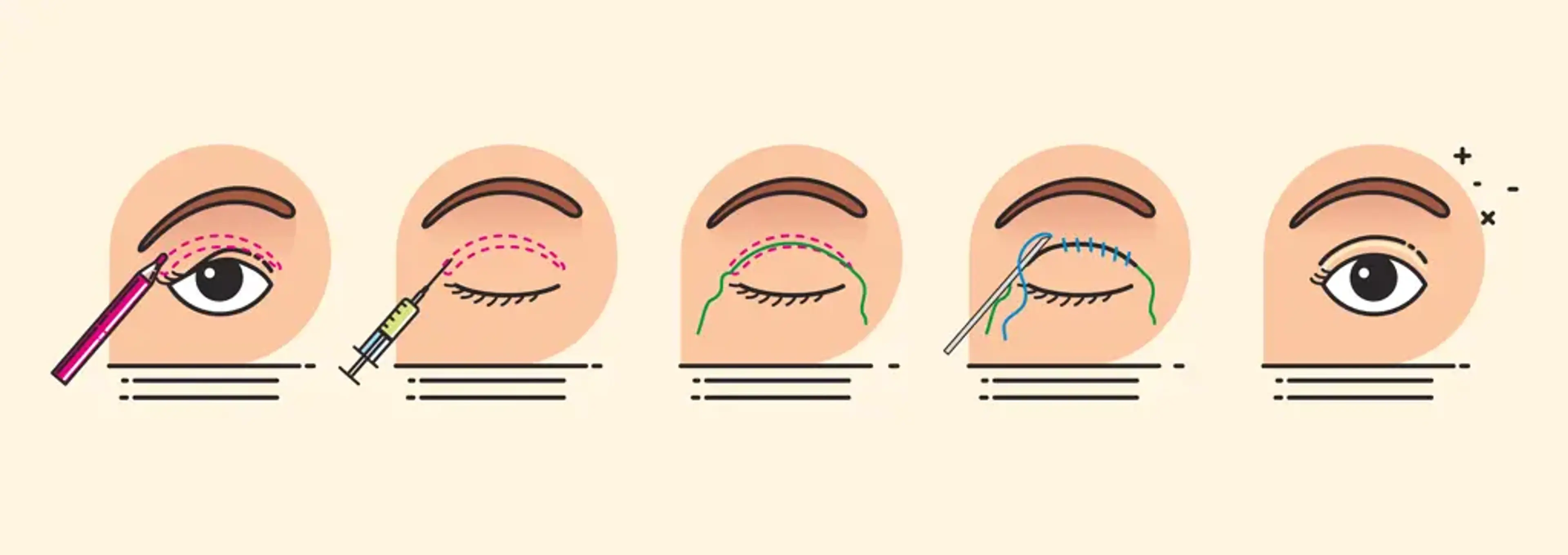
There are two main surgical approaches, each tailored to different anatomical and aesthetic needs:
This technique uses ultra-fine sutures to create a natural fold without cutting the skin. It’s minimally invasive, leaves no visible scar, and offers a faster recovery. It’s ideal for patients with firm skin and minimal excess fat.
Here, a fine incision is made along the planned crease to remove excess fat, skin, or muscle. This allows for a more defined and long-lasting result, especially in patients with drooping eyelids, asymmetry, or puffiness.
Both techniques aim for the same outcome — eyes that look natural, balanced, and true to your facial identity.
Our clinic’s name — 1mm Plastic Surgery — isn’t just branding. It’s a belief.
In eyelid design, one millimeter can determine whether your eyes look gentle or sharp, natural or surgical, harmonious or off-balance. Even the slightest difference in crease height can change how your entire face is perceived.
A 1mm higher crease might make the eye look brighter and more open, while 1mm lower can create a softer, subtler look. That level of precision requires more than surgical skill — it requires an artistic eye trained to read emotion, proportion, and light.
We often tell our patients:
“Millimeters are not numbers — they are emotions translated into design.”
Every crease is planned according to the patient’s brow position, skin thickness, muscle strength, and even the way the eyes move when smiling. These fine calibrations ensure that the final result looks not “done,” but natural — as if you were simply born that way.
To truly appreciate double eyelid surgery, it helps to understand what’s happening beneath the skin.
The upper eyelid is made up of delicate layers: skin, fat, muscle, and the levator aponeurosis — the tendon that lifts the eyelid. When there’s no natural crease, this tendon doesn’t attach to the skin surface.
During surgery, the surgeon creates or reinforces this attachment, allowing the skin to fold naturally when the eyes open.
This process must be done with millimeter-level precision, because the fold’s depth, height, and symmetry depend on how these tissues are connected. A skilled surgeon knows exactly how much to adjust — just enough to create definition, but not so much that the eyes lose softness or mobility.
Before any incision or suture is made, the most important step happens: the design consultation.
At 1mm Plastic Surgery, we spend significant time studying your eyelids while your eyes are both open and closed, at rest and in motion. We analyze how your lashes curve, how your brows move, and how your eyes express emotion when you speak or smile.
We then simulate various crease shapes using a temporary marking tool, so you can visualize how subtle changes — even half a millimeter — alter the overall feel of your eyes.
Neither design is inherently better; the right one is simply the one that feels most you.
Because every person’s eyes are unique, cookie-cutter designs never work. Your ideal crease should harmonize with your bone structure, expression, and even personality.
Double eyelid surgery is typically performed under local anesthesia with light sedation, so patients remain relaxed and comfortable throughout.
Both methods are pain-free during the procedure, and patients can go home the same day. Most people return to daily life within 3–7 days, depending on the technique.
At 1mm Plastic Surgery, we use micro-surgical tools and high-magnification visualization, allowing unparalleled precision and minimal tissue trauma. This approach ensures faster healing, less swelling, and beautifully fine results.
Even confident patients often share similar worries. Let’s address a few of the most common ones:
A natural result depends on balance, not the crease itself. The most beautiful eyelids complement the rest of the face — they don’t dominate it. By customizing the crease height, curve, and thickness, we ensure it flows seamlessly with your natural features.
No two eyes are perfectly identical — even before surgery. But an expert surgeon accounts for these subtle differences. At 1mm Plastic Surgery, we often perform levator correction to even out differences in eyelid muscle strength, creating a more symmetrical, harmonious look.
Non-incisional techniques can last for years — and sometimes permanently — if performed with skill. The incisional method typically provides lifelong results, although aging may naturally alter the appearance over time.
Recovery from double eyelid surgery is generally straightforward. The key is patience — because the eyes go through several stages of healing before revealing their final beauty.
We recommend sleeping with your head elevated, avoiding heavy exercise for 1–2 weeks, and refraining from rubbing the eyelids.
At 1mm Plastic Surgery, we guide every patient through a personalized post-operative care program — including gentle lymphatic treatments to reduce swelling and regular follow-ups to ensure smooth healing.
In Seoul, there are countless clinics offering double eyelid surgery — but true artistry and safety come only from experience, precision, and philosophy.
We take pride in helping patients from Korea and around the world achieve natural results that honor their individuality — using techniques that prioritize minimal incision, minimal downtime, and maximum precision.
Double eyelid surgery isn’t just a cosmetic procedure — it’s a study in precision, harmony, and emotion.
When performed thoughtfully, it can restore not just balance to your features, but also confidence to your expression. The goal isn’t transformation — it’s revelation.
At 1mm Plastic Surgery in Gangnam, we understand that every patient carries a unique definition of beauty. Our role is to listen deeply, design carefully, and refine precisely — one millimeter at a time.